Cyrano or the non-classical 17th century writer/philosopher
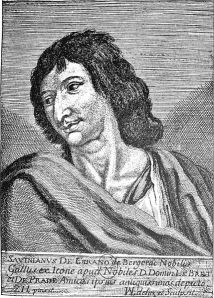
My research has also taken me to the 17th century (1657) to the work of Cyrano de Bergerac. The Other World : The States and Empires of the Moon and The States and Empire of the Sun. In my goal to trace representations of death in the canon (although the canon has tried to forget Cyrano – but this is a matter for another time and place) I performed a close reading of this marvelous text that crosses over many genres and defies labeling. On the surface science fiction (flying to the moon and the sun) yet really engaging many genres to create a utopian redefinition of society. Through inversions, the author manages to attack, critique and show his disdain for religious, political and social orders. Yet, we must admit that it is only science fiction on the surface because the secret thread that binds the two large sections of the text (voyage to the sun/voyage to the moon) is a complex philosophical discourse that at best could be described as an anti-system. This is the book of inversions where the author refuses, following no doubt the footsteps of Montaigne, a tradition of instability: normative codes of gender, logic and narratology are turned on their heads. And I say it is an Anti-system as it refuses to claim allegiance to a system of thought (or elaborating an eclectic new one?). In fact, the narrative voice (Je/Dyrcoma) advances that opposing views can coexist when Gassendi and Descartes (as philosophers/angels in the sun/heaven) have finally glossed over their differences (Descartes’ Universal doubt – something that Gassendi rejects – and Descartes refusal to accept the void -something that for Gassendi had to exist to explain movement)
Characters change gender throughout the text; the narrator will be both first person singular (JE) and third person singular Dyrcona (a reorganization of the name Cyrano); his travels will be both an ascent and a descent since the sun and the moon will be both in the center of the earth and beyond it. Je/Dyrcona will be constantly freed and imprisoned by supernatural beings that insist on putting “Man” on trial.
I was particularly interested in following his treatment of death to link it to his “opaque” or anti-systematic philosophy. I am not sure I have been able to link the two, not sure if this is something I want to push forward…
Yet if we consider the sun as a utopian world that also represents the afterlife (after all that is where all souls go after their death and philosophers get to debate their systems in all freedom) does the text consider death as good?
249 : « La mort, me dirent-ils (me mettant le bec à l’oreille), n’est pas sans doute un grand mal, puisque Nature notre bonne mère y assujettit tous ses enfants ; et ce ne doit pas être une affaire de grande conséquence, puisqu’elle arrive à tout moment, et pour si peu de chose ; car si la vie était si excellente, il ne serait pas en notre pouvoir de ne la point donner ; ou si la mort trainait après soi des suites de l’importance que tu fais accroire, il ne serait pas en notre pouvoir de la donner. »


Leave a Reply